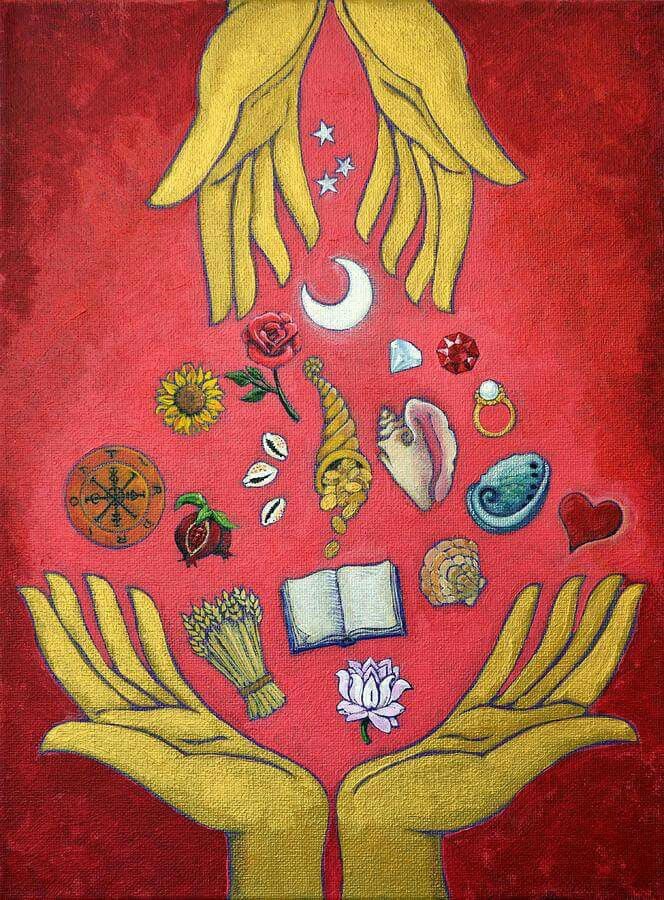
Martín Prechtel, author and teacher, instructed me years ago about not giving “back of the fridge” gifts. What he means is that when it’s time to give a gift for whatever occasion, don’t give away the thing you already don’t want. Something you’d even be likely to throw away, the least good thing in your fridge. He was teaching us about a quality of generosity sadly absent in modern practice. The notion that when you give, you should choose your best thing. Maybe it’s a handmade item that took you months to craft, that shines with beauty. The thing that stings to part with. That is a true gift and that gift carries an energy you can’t put a price on. In fact, when you give that sort of gift, you enrich yourself as well as the other. You encourage a culture of dignity and resist a culture of selfishness.
The Psychology of Abundance
Generosity is an essential glue to a happy life. When we are generous, we are in touch with a sense of abundance. Even if we don’t have very much materially, when we give, we feel rich. Because we are rich when we give. There is a force that is birthed inside of us when we give with true generosity.
And generosity is a two way street, an act that is a partnership. When you are given something, you are being invited into this partnership and it is your job to do your part in the circular flow of energy. To receive well is to give an invisible yet very real and viscerally felt gift back to the giver. The two of you form a bond that knits together the fibers of the human community.
Prechtel teaches about an ethos of indebtedness that is radical to the modern idea of debt. He says that it is actually being indebted to one another that connects us, that keeps us cognizant of our interdependence and helps us remember to turn to one another when we are in need. Entering into a life of more generosity, of giving and receiving well, is an antidote to loneliness, depression, anxiety, and meaninglessness.
Lessons from the Tz’utujil Maya: When Everyone Is Royalty
In many tribal cultures, including the Tz’utujil Mayan where Prechtel was an integral member of the spiritual village hierarchy, the people embody nobility. Each woman is a queen and each man a king (gender fluidity included). The essential and archetypal nature of a king or queen is to be magnanimous, strong yet fair, wealthy and also generous with that wealth.
When someone in the village amassed a great amount of riches - food, materials, cash, or other valuable substances, he or she would in short order host an enormous feast and celebration to give away their riches in a fabulous offering to the community, including the natural and spirit realms. They would be left with next to nothing, yet the community would be indebted to that person and always make sure he or she was taken care of well. Furthermore, everyone, not the least being the generous host, was completely filled up with good feelings and nourishment. If you have ever been the bestower of a great gift or offering, and that gift was received well, you know this feeling. The sum becomes greater than the individual parts. Everyone and the larger collective field is fed and feelings of belonging, gratitude, and wholeness blossom.
This understanding about mutual indebtedness turns our modern aversion to being beholden to anyone else or indebted to them on its head. Instead of being afraid of being tied to others, we can begin to realize this is foundational to feeling true belonging and connection. Cycling through the village, everyone would be doing this for everyone else, over and over, all giving generously, receiving all the abundance available in the whole, all indebted to each other as the tight knit family they were.
And we can still do this. We need to do this for the health of our world and for our personal well beings. Even if in small ways within the communities with which we are linked.
The Great Feast: Recognizing Nature’s Generosity
This power of generosity is not limited to the human members of our world. Abundant generosity is exactly what is happening all around us every second. When we start to see this, we start to deeply know the meaning of the phrase, “We are all related.” The earth, the sun, the waters, the air, all the beings who feed us with their bodies, these are the noble kings and queens who are feasting us everyday. As humans, it is our job to recognize that this is such and to respond with praise, celebration, gratitude, songs, dances, and prayers of thanks to these great royal entities that feed us and make it so we can live well.
Though most of us reading this are not living in culturally intact, tribal villages, we can still live by these principles of mutual indebtedness, gratitude, and generosity in our everyday lives, with our neighbors, at work, in public spaces, and with the natural world itself.
The Ripple Effect: Small Acts, Profound Impact
When we recognize this cornucopia of gifts that is being given to us daily, we start to participate more. In modern parlance, there is the concept of “pay it forward.” This is the idea that if you receive a gift from someone or something, you can pass it on by offering an act of generosity to another, not necessarily the original person who gifted you. This is not just a “nice” thing to do. It’s what can heal our fractured society.
Every time you stretch yourself to give, be it a kind word to a stranger or a potted plant you cultivated to a neighbor, you are seeding the ground of our world with this ethos of generosity, of courtesy, of gratitude. When you feel full, you can feel grateful. When you are grateful, you are more able to give. When you give, you become rich. You are aligning your actions with the actions of the great natural world, with Gaia, who is offering abundance every second. You are joining the real stream of generosity that is the nature of this reality.
A Stranger’s Gift: Three Words That Created a Ripple
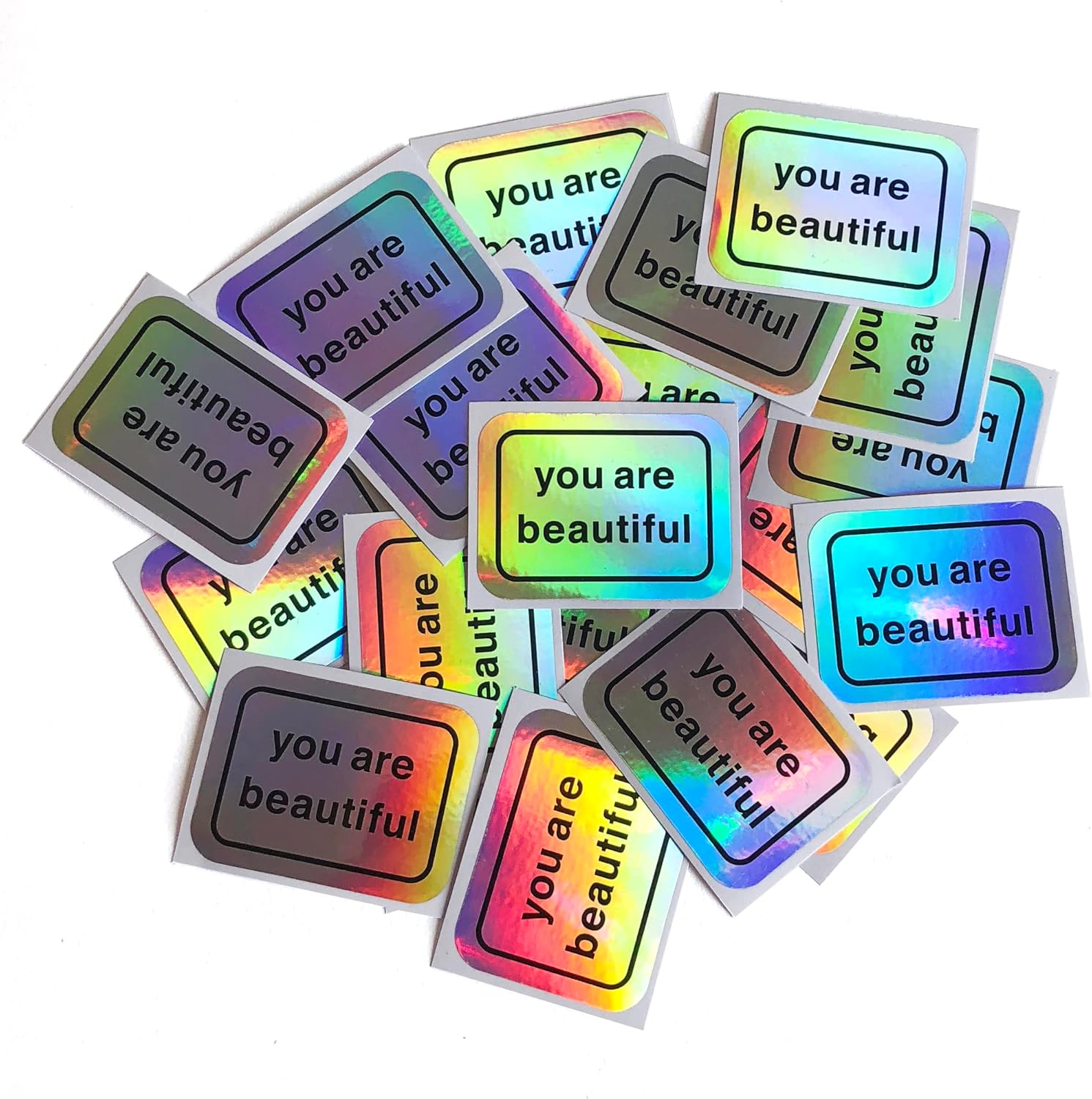
A memory that has stayed with me for over 20 years was one day when I was walking down the street in San Francisco and I got a gentle tap on the shoulder. Standing there was a young woman with cropped dark hair, huge dark eyes and a smile to fill the universe. She said not a word but politely handed me a small slip of paper about the size of a fortune cookie. She was standing with her feet together and held out the paper with two hands, like she was delivering something with great respect. Like an offering, with a slight bow.
Once I had taken it from her, she turned and walked away gracefully yet swiftly. I looked down to read the handwritten words: You are beautiful. That was all. I looked back up and she was nowhere to be seen. There was no expectation or agenda coming from her, I could feel that. She simply gave me this drop of psychic nectar, and left, trusting no doubt, that whatever was to become of that exchange was now out of her hands and in the hands of the great mysterious flow of cause and effect. I think at the time I also had the bumper sticker on my car that read: Practice Random Acts of Kindness. She was creatively doing just this. Since then I have left dozens of kind notes on random peoples’ cars, offered more compliments to strangers, and plan to do more. Her one act of selfless generosity mushroomed into countless sparks of nourishment.
Breaking the Scarcity Spell
Believing in scarcity is a way to deprive the world of the juice it needs to thrive. When you see the lack, when you fixate on what you don’t have or what is not available, you become more stingy, clutching to the little you perceive you have. You give less, and others receive less. That magical moment of giver and receiver and the third invisible energy source that is a substance called belonging and wholeness is missed. You have the power to spark this abundance in each day through the generous actions you take. If you have little material wealth, use your words. Use your hands. Use your face. You have so much to give.
The Art of Generous Boundaries
Of course we want to be sensitive of being taken advantage of. The mind and body that is You is just as important to be generous to as the other person or being. For sure take care of yourself and be mindful of who you are engaging with. Sadly, there are people who take too much or suck your energy or resources. You need to know when to hold boundaries when you feel this happening.
But even with these folks, you can be generous with your thoughts. In the privacy of your own mind and heart, instead of blaming or criticizing them, bless them with hopes that they will find their way to a more balanced existence. The Buddhist practice of Metta is a wonderful form to learn to do this. This not only helps you strengthen your habit of generosity and kindness, it changes how you behold humanity. Instead of mistrusting people as a default mode, we can live generously while being smart about necessary boundaries. There is an old Arabic phrase: “Trust in God, but tie your camel.”
Practice: Stretching Your Generosity Muscle
You can gauge when being generous feels fruitful to you and leaves you with a feeling of upliftment vs. draining and likely to seed resentment or regret. This can take some experimentation. You can begin by stretching your edge of generosity. You don’t have to give anything physical or monetarily valuable to be generous. Sometimes the words you use and the thoughts you are holding are the most generous things you can give.
Try slowing down the next time you thank someone for something, even the coffee being handed to you by your barista, make eye contact, and practice being a little more generous in the sentiment you pack into your “thank you.” It can help to remember that this is a human being with joys and pains just like you. You have no idea what is going on in their life. They may be having a bad day. Or had one recently. Or will have one tomorrow. Every ounce of human kindness they receive (or ill-will) will add up in their system and influence them, which in turn influences the entire world through the physics of cause and effect.
Realize that all your actions have a ripple effect, positive, negative, or neutral. After stretching your generosity muscle in some way, check in with yourself to see how you feel. When you feel pleasure after an instance of generosity and pause to be aware of that, to enjoy that moment and feel grateful that you were in a position to give, you reinforce this habit in your mind. This is not about feeling better than anyone or being smug about how great you are. This is about participating in the great reality of an abundant universe and yourself being filled up with the goodness of that.
A Lesson from Delhi: The Subtleties of Receiving
I had an experience when I was traveling in India which I can now understand as a lesson on generosity and indebtedness. I had been staying with a pair of Indian brothers, friends of a friend, who had automatically taken me in as if I was family. I spent a week here and there at their posh (for India) air-conditioned flat in Delhi in between longer stretches of backpacking and roughing it. I called it my vacation within a vacation.
At the end of my stay in India, I wanted to gift them something to show my gratitude. I had found a rare, fancy restaurant in their neighborhood that had great Western-type food. I bought them a $75 gift certificate, thinking it would be fun for them to splurge and have a luxurious meal there. But when I gave them the certificate on my last day with them, it seemed like I had slapped them in the face. They were basically polite, but it was obvious they were in no way thrilled about the gift. Actually they looked a bit disgusted.
At the time I was confused, but I’ve come to guess that what I had done was in essence nullified their generosity by freeing myself (paying my way out) of my debt to them, and therefor a deep, special connection that we had been forging. This wasn’t my intention, but I learned a valuable lesson about being mature enough to graciously receive generosity (ironically, sometimes harder than the giving but equally important!) I wonder if I was unconsciously avoiding some sort of anxiety in myself that I would have carried had I not given them that monetary gift. A heartfelt card or words of gratitude would probably have been better received.
Conclusion: Weaving the Web of Belonging
In our hyper-individualistic culture, we’ve forgotten something essential: we are not meant to be islands. The threads that connect us are made visible through acts of generosity—both in giving and receiving. When we give our best, when we receive with grace, when we allow ourselves to be beautifully indebted to one another, we create the conditions for true belonging.
This is not about perfection or always getting it right. I certainly didn’t with my Indian hosts. It’s about remembering that every interaction is an opportunity to either strengthen or weaken the web that holds us all. In a world that often feels fractured and lonely, our small acts of generosity become radical acts of healing—not just for others, but for ourselves and for the very fabric of our communities.
The woman who handed me that slip of paper in San Francisco understood this. She gave freely, without expectation, trusting in the mysterious flow of cause and effect. She participated in the great abundance that surrounds us always, if only we have eyes to see it. We can all be part of this ancient, sacred economy of gifts. We can all be queens and kings, generous with our wealth of words, presence, and care.
The invitation is always there, waiting for us to accept it: to step into the stream of generosity that is the very nature of reality itself.
P.S. A great book I’ve found for kids to start teaching about the valuable act of giving is Have You Filled a Bucket Today? by Carol McCloud. So good!